
102 North Highland Avenue
Marfa, Texas
In January 1990, Judd purchased the Glascock Building located in downtown Marfa. Built at the turn of the twentieth century, the 5,000-square-foot building was originally operated as a store and later housed various commercial businesses.
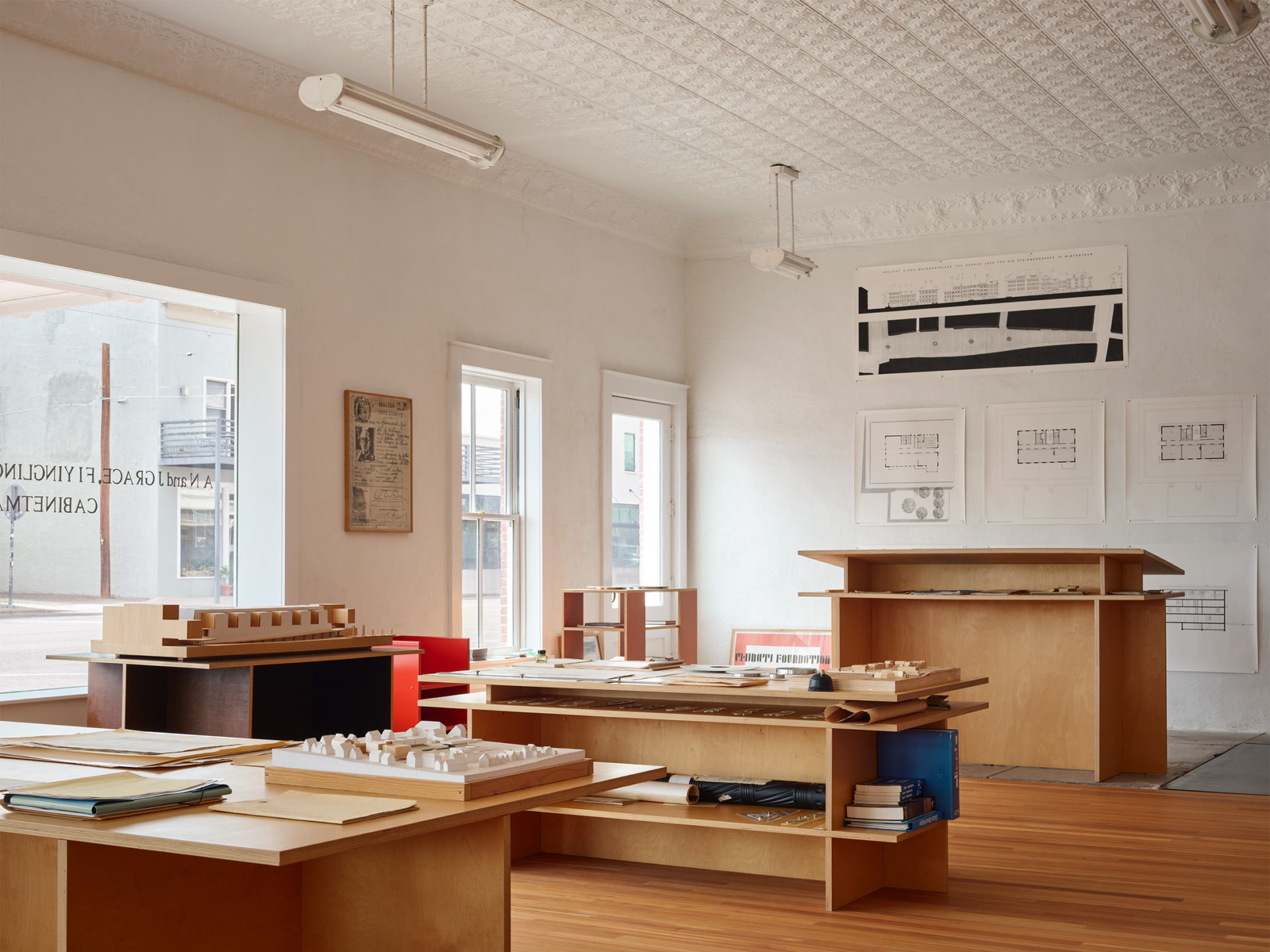
Sited in direct proximity to Judd’s Architecture Studio, the street level of this two-story structure was renovated by Judd for use as his Architecture Office. The Architecture Office is a primary example of Judd’s practice of repurposing existing buildings and restoring historic structures in New York and Texas.
The ground floor contains furniture and design objects by Judd, as well as plans and models of his architectural projects in the United States and Europe, including the Basel Bahnhof and his former Swiss residence, Eichholteren. Judd intended for the second floor of the building to function as a living space for guests. The largest of these spaces was installed with a permanent installation of six paintings by John Chamberlain, furniture by Alvar Aalto, and furniture by Judd.
The Architecture Office is a contributing building to the Central Marfa Historic District listed on the National Register of Historic Places.
The Architecture Office is the first major building project to be completed in Judd Foundation’s long-term restoration plan for its buildings in Texas. Following a seven-year restoration and rebuilding, Judd Foundation reopened the building to the public in September 2025.
Audio excerpt of an interview with Donald Judd by Regina Wyrwoll for the television documentary Bauhaus, Texas, October 4–5, 1993. Courtesy The Chinati Foundation Archives, Marfa, Texas. Film © Judd Foundation.
Planning for the restoration of the Architecture Office began in 2014. The project was designed to conform to the highest qualities of preservation, meeting the Texas Historical Commission’s Standards for Rehabilitation guidelines for historic preservation issued by the National Park Service. In 2018, construction for the restoration project began with the support of the National Trust for Historic Preservation.
Schaum Architects
Project Architects
Houston, Texas
Alpha Masonry
Historic Masonry Consulting
Winnipeg, Canada
GK Engineers
MEP Engineering
Bellaire, Texas
Higgins Quasebarth & Partners
Historic Building Consulting
New York, New York
High Desert Woodworks
Historic Carpentry
Marfa, Texas
Image Permanence Institute
Environmental, Preservation, and Conservation Consulting
Rochester, New York
KCI Technologies
MEP Engineering
Downers Grove, Illinois
Method Building Company
General Contractors
Marfa, Texas
RC Concepts
General Contractors
Marfa, Texas
Simpson Gumpertz & Heger
Engineering
New York, New York
TYLin Engineering
Engineering
New York, New York
Transsolar KlimaEngineering
Energy Engineering
New York, New York
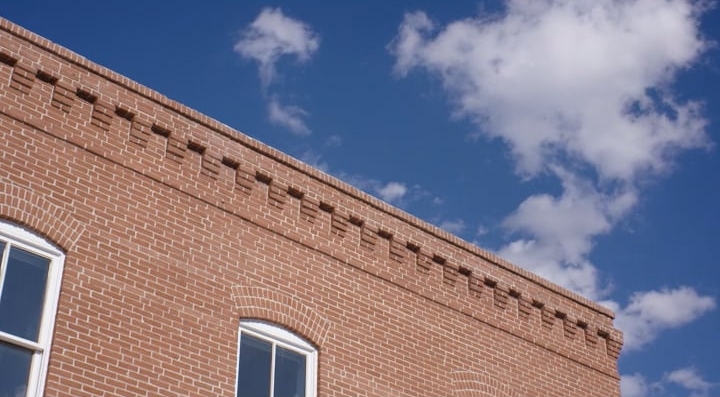
The first phase of work began in 2018 and focused on the building envelope, using traditional masonry techniques to repair and repoint the brick façade while maintaining the building’s original aesthetic. Leaks and damage to the original windows, most of which had been boarded up, were also addressed. All exterior wood windows and historic wood and copper storefronts were rebuilt by hand; original brass door and window hardware was refinished and reinstalled. Energy efficient glazing was incorporated while maintaining the historic look and operation of the windows and woodwork.
The second phase of work, which began in 2020, addressed the interior spaces, preparing them for the safe reinstallation of artworks and design objects, as well as for visitors and public outreach. Spaces permanently installed by Judd were given extra attention; floors were repaired and stabilized, and window and door treatments were improved to protect the work inside. Previously, objects had been housed in unconditioned areas with large variations in temperature and humidity. The project team determined that the advanced mechanical systems typically used for museums and preservation were neither feasible nor desirable in this arid remote location.
Instead, the project team researched and specified passive and light mechanical systems to achieve the required interior conditions. The collection will be kept within an acceptable climate range using an innovative outside-air system that senses the desert’s natural daily temperature swings and shifts accordingly. The second-floor installed spaces were also restored to match the conditions in which Donald Judd left them, but with an upgraded kitchen and bathrooms in keeping with the original architecture, and with energy efficient heating, cooling, and lighting systems in place.
For the second restoration and rebuilding post-fire, working with Judd’s architectural precept of considering existing structures as complete systems, the project team implemented a number of energy conservation and sustainability practices that assessed the building as a whole, including
Major support for the restoration of the Architecture Office was provided by the Judd Foundation Board of Directors; The Brown Foundation, Inc. of Houston; The Horace W. Goldsmith Foundation; Dudley and Michael Del Balso; Suzanne Deal Booth; and an anonymous donor. Additional support was provided by The Summerlee Foundation; The Cynthia Woods Mitchell Fund for Historic Interiors of The National Trust for Historic Preservation; The Hart Family Fund for Small Towns of The National Trust for Historic Preservation; the City of Marfa; and E.R. Butler & Co.